%20(1).svg)


.png)


.png)

.png)


In reality, laying hens frequently face numerous stressors such as environmental fluctuations, handling procedures, high stocking densities, or imbalances in their diets. Any of these factors can disrupt metabolic processes and reduce farm productivity.

When poultry are stressed, corticosterone levels in their bodies increase. This increase promotes oxidative stress, reducing the number of developing follicles and damaging follicle cells, directly leading to a decrease in egg production. In addition, stress causes poultry to prioritize using energy for survival rather than focusing on egg formation. One common stress response is panting, which causes excessive CO₂ loss. This CO₂ loss alters the blood’s acid-base balance and reduces available calcium ions, two essential elements in eggshell formation.
Because eggshells contain up to 95% calcium carbonate (CaCO₃), any disruption in calcium metabolism immediately impacts shell quality. Decreased CO₂ and increased blood pH impair calcium bicarbonate formation, resulting in thinner shells, increased cracking, and a higher number of deformed eggs. In short, stress not only leads to energy and nutrient loss but also comprehensively affects egg weight, shell thickness, and durability. This causes a decrease in production efficiency, directly impacting the profitability of farmers and integrated livestock units.
Phytocee by Natural Remedies: Enhancing egg quality and laying hen performance.
To help chickens overcome stressors and strengthen their natural defenses, Natural Remedies has developed Phytocee – a scientifically proven herbal feed supplement. The product is designed to boost immunity and support poultry in maintaining performance under adverse conditions.
The mechanism of action of Phytocee is reinforced by commercial trial results, showing significant improvements in egg weight, nutrient utilization efficiency, laying rate, shell quality, and egg freshness. These consistent data demonstrate the product’s ability to support optimal performance in flocks, even under stress. Phytocee supplementation has shown clear benefits:
- Improving Hen Day Egg Production (HDEP)
- Increase egg weight and volume.
- Increasing the Haugh unit value helps improve the quality of egg whites.
- Increase eggshell thickness and density.
- Reduce casing defects and breakage rates.
By increasing stress tolerance, Phytocee helps redirect energy back to productive functions, resulting in stronger eggshells, healthier flocks, and more consistent yields.
Improve egg weight and nutrient utilization efficiency.
Stress disrupts metabolic activity, leading to nutrient allocation diverted away from egg synthesis. A 4-week field study conducted on Isa Brown laying hens of different age groups (Flock A: 10 weeks old, Flock B: 30 weeks old, Flock C: 50 weeks old), supplemented with 200 g/ton of Phytocee, showed significant improvement in nutrient uptake and utilization. This supplementation increased egg weight by 8–11% and helped maintain stable production across the three groups.
Evidence-based evaluation: Phytocee improves egg weight.

With Phytocee, poultry flocks can maintain stable egg production even when temperatures fluctuate or the farming environment is challenging. This reflects its ability to improve feed efficiency and help balance overall metabolism, thereby supporting the flock in maintaining productivity throughout the laying cycle.
Egg production efficiency
Phytocee plays a crucial role in improving egg production. An internal trial showed that Hy-Line chickens supplemented with 500 g/ton of Phytocee had their daily egg production increase from 10,771 to 10,975 eggs, corresponding to a 3% improvement in HDEP.
Test results:
| Group | Eggs/day | Actual HDEP (%) | Difference | HDEP standard | Difference |
| Baseline | 10,771 | 77 | – | 92.80 | -15.80 |
| Phytocee (500 g/ton) | 10,975 | 80 | +204 | +3 | 91.75 |
This effect stems from the powerful combination of Withania somnifera, Emblica officinalis, and Ocimum sanctum, providing adaptogenic, anti-stress, and antioxidant effects, helping chickens increase resistance, balance reproductive hormones, and enhance overall immunity—thereby improving egg production and quality.
Improve eggshell quality
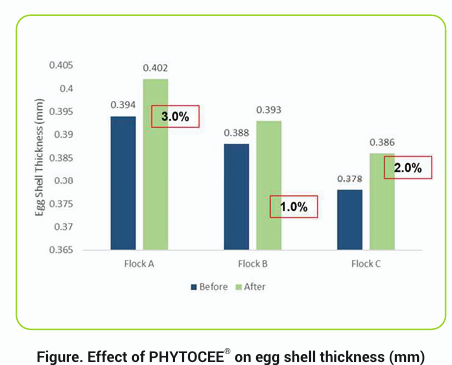
Phytocee supports improved eggshell quality by promoting ion balance, enhancing antioxidant capacity, and facilitating more efficient calcium metabolism. A 4-week field study on Isa Brown chickens in three age groups (A: 10 weeks, B: 30 weeks, C: 50 weeks) showed that supplementing with 200 g/ton of Phytocee increased shell thickness by 1–3% and improved structural strength of the eggshell.
As a result, the rate of cracked and unshelled eggs has decreased significantly, contributing to an increase in the number of marketable eggs and improving the economic efficiency for farmers and livestock farms.
Evidence for evaluation: Impact of Phytocee on shell thickness (mm)
Enhance egg freshness
Phytocee is a herbal additive that improves egg freshness thanks to its strong antioxidant properties and adaptogenic effects, directly impacting quality indicators.
Impact on egg freshness
- Phytocee improves egg white quality, measured by the Haugh unit, an important indicator of egg freshness.
- In a study on BV 300 chickens, Phytocee increased Haugh unit values, reflecting better egg white height and stability over time.
| Haugh Unit (HU) | 3 weeks | 6 weeks |
| Control | 50.2 | 56.9 |
| Phytocee | 55.1 | 61.05 |
Improvement in Haugh Unit score with Phytocee supplementation.
- Egg white height and Haugh unit are directly related to egg freshness; groups supplemented with Phytocee maintain higher values during storage, making eggs less susceptible to environmental and storage conditions.
Reduce shell deformities and maintain stability.
Stress often leads to uneven production and eggshell defects. Phytocee helps minimize these problems by maintaining antioxidant balance and regulating immunity. As a result, chickens significantly reduce shell deformities while maintaining consistent egg size and durability throughout the cycle. The result is stable egg production and reliable quality, meeting the requirements of the commercial supply chain.
Immunity: The foundation of egg quality
The productivity of each chicken depends closely on the effectiveness of its immune system. When stress occurs, immunity weakens, causing the body to redirect nutrients from production to defense. Phytocee enhances immunity, helping chickens maintain health, fitness, and productivity even under stressful conditions. Thanks to this internal balance, calcium, protein, and essential nutrients are prioritized for egg production, instead of being used to cope with stress.
Advantages of Phytocee
Phytocee improves egg quality by strengthening both the shell structure and internal elements, while also helping chickens withstand stress better. The product’s herbal formula supports immunity and enhances the freshness and shelf life of the eggs.
Key benefits:
- Improve shell strength, shell weight, shell thickness, Haugh unit, and egg white height.
- It provides strong antioxidant and adaptogenic effects, helping to reduce corticosterone levels and increase stress tolerance.
- It enhances cellular immunity and reduces oxidative stress, contributing to the maintenance of stable egg quality and protein stability.
By supporting stress management and immunity, Phytocee enhances both the nutritional and commercial value of eggs, providing a reliable solution for improving egg quality in laying hen farms.
*Dosage may vary by region.