%20(1).svg)


.png)


.png)

.png)


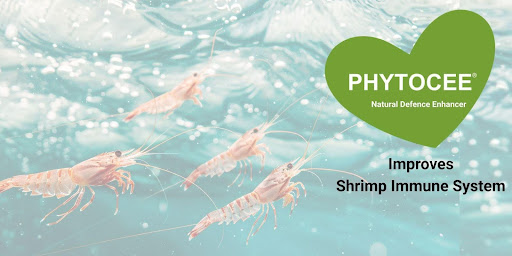
Shrimp Immune System is Different
Shrimp farming is growing rapidly, but the shrimp immune system works very differently compared to mammals or fish. Shrimp cannot produce antibodies, so when pathogens enter, infections such as White Spot Syndrome (WSSV) can spread quickly across the entire population. Their protection relies only on innate, non-specific cell-mediated defences that react immediately but can be easily overwhelmed. Understanding the shrimp immune system is essential for preventing outbreaks and improving survival while supporting steady shrimp growth.
Innate Defence: No Antibodies, No Vaccination
Shrimp cannot be vaccinated because they lack antibodies. Hence, once stress levels rise or pathogen load increases, this non-specific system cannot keep up — making disease management a major challenge in aquaculture and directly impacting shrimp growth.
Stressors That Weaken Shrimp’s Immune System
Shrimp are constantly exposed to multiple stress factors:
- Fluctuating salinity
- High ammonia levels
- Excess CO₂
- Toxic H₂S
- Temperature swings
- Untreated water
- Poor biosecurity
- Overstocking
How Phytocee Improves Shrimp Immune System?
Phytocee, a phytogenic feed additive, enhances the shrimp’s immune system by acting as an adaptogen, which in turn improves survivability and reduces mortality under viral and salinity stress.
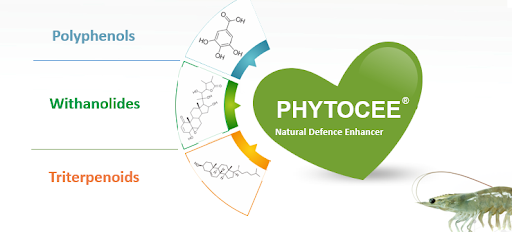
Phytocee contains herbs such as Emblica officinalis, Withania somnifera, and Ocimum sanctum, which are rich in phytoactives including polyphenols, withanolides, and triterpenoids that exhibit antistress, antioxidant, and immunomodulatory properties.
Phytocee enhances non-specific defence mechanisms, improves stress tolerance, and thereby strengthens overall immune responsiveness in crustaceans.
Phytocee’s Impact on Survivability and Salinity Stress Under Normal Conditions
A 42-day feeding trial was conducted using SPF Litopenaeus vannamei under non-challenged conditions, and the design study is as follows:
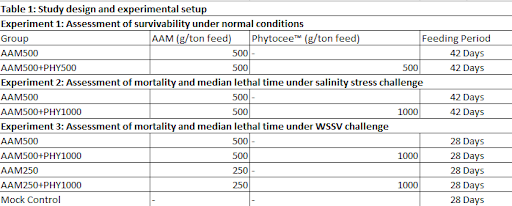
Note: AAM- Ascorbic acid monophosphate; PHY- Phytocee™; MLT-Median lethal time.
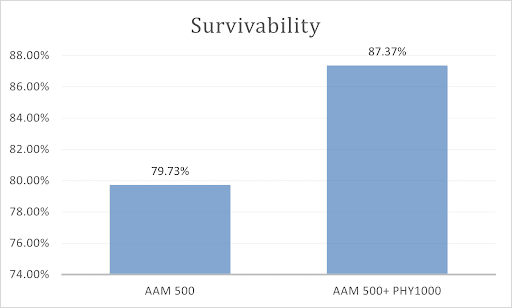
Impact of Phytocee™ on the survivability of Litopenaeus vannamei shrimp without challenge
Results:
- AAM500(Control survival) %: 79.73 ± 2.74%
- AAM500+ PHY500 (Phytocee survival) %: 87.37 ± 3.85%
Phytocee’s Protection Against Salinity Stress
To model osmotic stress, shrimps were exposed to a salinity shock from 20 to 0 ppt after 42 days of feeding, and mortality and MLT (minutes) were measured over 6 hours. Two groups were compared:
Mortality:
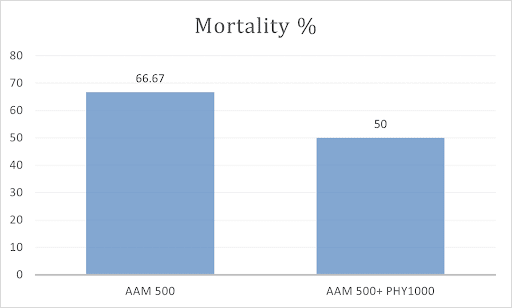
Impact of Phytocee™ on the mortality of Litopenaeus vannamei shrimp under salinity stress challenge
When supplemented with Phytocee, shrimp mortality was reduced by 16.67% under salinity stress conditions.
Median Lethal Time (MLT):
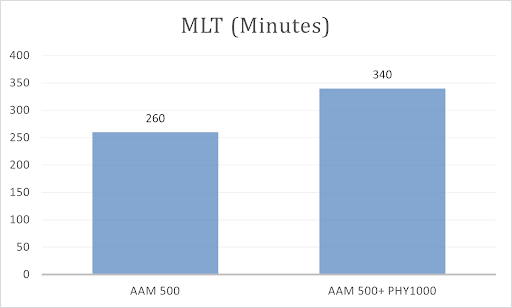
Impact of Phytocee™ on MLT of Litopenaeus vannamei shrimp under salinity stress challenge
Phytocee supplementation reduced mortality by 16.67% and extended MLT by 80 minutes, showing stronger stress endurance and better ability to withstand acute osmotic shock. This improved endurance reflects enhanced energy status and anti-stress capacity, which are critical components of functional innate immunity in shrimp.
Phytocee Provides Protection Against WSSV
White Spot Syndrome Virus (WSSV) remains one of the most viral threats in shrimp farming. Phytocee at 1000 g/tonne reduced WSSV‑induced mortality in both AAM250 and AAM500 backgrounds, with the lowest mortality (43.33%) observed in AAM500PHY1000. In the AAM250 background, Phytocee lowered mortality by approximately 10% (66.67% vs 56.67%) and extended MLT from 84 to 96 hours, indicating delayed and reduced death under viral challenge.
For more details, read the WSSV in Shrimp article
Conclusion
Across normal conditions, viral challenge, and salinity stress, Phytocee consistently demonstrated its role as an adaptogenic immunomodulator:
- Improved survivability under routine culture conditions
- Reduced mortality and delayed lethality during WSSV infection
- Enhanced tolerance to acute salinity stress
- Stronger non-specific immune responses and stress coping ability
These effects are driven by the synergistic action of E. officinalis, O. sanctum, and W. somnifera.
By strengthening the innate shrimp immune system, improving stress tolerance, and supporting physiological balance, Phytocee helps shrimp withstand real-world farming challenges. When immunity is stable, survival improves, sustainable shrimp performance becomes achievable.