%20(1).svg)


.png)


.png)

.png)



Livestock production is fundamental to global food security, human nutrition, and economic development, supporting millions of livelihoods worldwide. As consumer expectations evolve, the industry is increasingly focused on improving production efficiency, product quality, animal health, and environmental sustainability.
Within this context, choline is a key nutritional component that directly influences productivity, metabolic health, and profitability across animal production systems.
Why Choline Matters in Animal Nutrition
Choline is an essential nutrient with lipotropic, metabolic, and structural functions. It plays a central role in contributing to cellular integrity, nervous system function, and lipid metabolism.
Key physiological roles of choline
- Methyl donor in transmethylation pathways, supporting DNA methylation and metabolic regulation.
- Precursor of acetylcholine, essential for nerve impulse transmission and neuromuscular function.
- Structural component of phospholipids, critical for cell membrane integrity and lipid emulsification.
Role of Choline in Poultry Production
The role of choline in poultry production includes:
- Growth and feed efficiency: Young poultry have limited endogenous choline synthesis capacity, making dietary supplementation essential to achieve optimal feed conversion ratio (FCR) and weight gain.
- Egg production and liver health: In laying hens, choline is required for lecithin synthesis, a major yolk phospholipid that influences albumen content and yolk quality. Long production cycles increase susceptibility to metabolic disorders such as fatty liver syndrome. Choline supports hepatic lipid metabolism and helps prevent fatty liver, thereby sustaining productivity and health.
Importance of Choline in Ruminant
Choline is rapidly degraded in the rumen, limiting its bioavailability, which makes rumen-protected choline (RPC) critical in high-producing dairy cows.
Key benefits in ruminants
- Improves hepatic lipid export and reduces fatty liver and ketosis in early lactation
- Enhances milk yield and milk fat content
- Supports reproductive performance and metabolic health
Choline in Swine Nutrition
In piglets, choline supports phospholipid synthesis, improving nutrient absorption and increasing weaning body weight.
Choline Supplementation Practices in Animal Diets
Conventional supplementation relies on synthetic choline chloride (50%, 60%, and 70% concentrations). Adoption is influenced by biological performance outcomes and economic considerations.
Key markets such as Asia–Pacific, Latin America, and the Middle East–Africa (notably India and Brazil) are experiencing annual adoption growth of 8–10% driven by intensification and feed optimization strategies.
However, increasing focus on sustainability, feed stability, and long-term metabolic efficiency is prompting the industry to evaluate alternatives that can complement or optimize conventional choline programs.
Kolin Plus: A Natural Phytogenic Solution
Kolin Plus is a proprietary polyherbal formulation based on selected plant ingredients, primarily Acacia nilotica and Curcuma longa.
- Acacia nilotica is rich in polyphenols and is associated with antioxidant and liver-protective activity.
- Curcuma longa contains curcumin, known for supporting fat metabolism and antioxidant defence.
Together, these compounds support antioxidant activity and fat metabolism, which are key functions typically associated with choline.
Polyherbal Effects on Kolin Plus on Poultry Birds
The polyherbal effects of Kolin Plus have multifold benefits on poultry health. Some of the polyherbal effects of Kolin Plus include:
1. Egg Production Performance
Layers supplemented with Kolin Plus at an optimal inclusion level demonstrated improved egg production performance when compared with birds fed only a high-energy diet.
In a 12-week study on White Leghorn hens (43-55 weeks old) fed high-energy diets, the group with Kolin Plus at 500 g/ton showed only a -2.62% drop in average egg production over 12 weeks (from baseline 93.50%), better than synthetic choline chloride 1000 g/ton’s -4.95% drop and is similar to breed standard. It also cut feed intake per egg to just +0.79% change (121.79 g/egg average), versus +2.01% (119.71 g/egg) for choline chloride.
Average % of egg production in layers
| Group | Baseline | Avg (1-12) | Difference |
| HED+ POH 500 | 93.5 | 90.88 | -2.62 |
| HED+CCL60% | 96.54 | 91.59 | -4.95 |
| BV 300 Standard | 94.97 | 92.97 | -2.22 |
2. Feed Intake and Feed Efficiency
Feed intake patterns showed that birds receiving Kolin Plus consumed less feed per egg produced compared to control groups. This indicates better feed utilisation efficiency.
Lower feed intake per egg is an important indicator of nutritional efficiency, especially in commercial layer operations where feed cost plays a major role in profitability.
3. Eggshell Defects
Eggshell defect percentages remained within acceptable ranges across all groups. Birds supplemented with Kolin Plus showed no increase in shell defects, indicating that replacing synthetic choline with a polyherbal formulation did not negatively affect shell integrity.
Polyherbal Effects on Kolin Plus on Swine
Kolin Plus supports lipid metabolism and liver function in swine through its multi-botanical active compounds. Its phytogenic components enhance hepatic fat mobilization, support phospholipid synthesis, and improve metabolic efficiency, particularly during high-demand phases such as gestation, lactation, and rapid growth. By promoting better liver health and nutrient utilization, Kolin Plus contributes to improved feed efficiency, growth performance, and reproductive outcomes in pigs, while offering a sustainable alternative to synthetic choline chloride.
Polyherbal Effects on Kolin Plus on Ruminants
In a field study conducted across dairy farms in Karnataka, Holstein Friesian cattle were evaluated to assess the impact of Kolin Plus on biochemical parameters associated with milk production.Some cows received their regular diet, while others were given Kolin Plus at 40 g per cow per day for four weeks. Over time, the cows receiving Kolin Plus showed steady improvements in milk quality. Their milk fat percentage increased significantly from the second week onward, and their fat-corrected milk output showed a consistent upward trend. Blood analysis revealed higher cholesterol and triglyceride levels, indicating better fat metabolism, while liver enzymes and ketone levels remained stable—showing no negative impact on liver health or rumen function. The researchers concluded that Kolin Plus could mimic the biological role of choline chloride and support milk quality and overall health in dairy cows.
Key Results Snapshot (Story-Support Table)
Milk Fat Improvement Over Time
| Group | Baseline | Week 2 | Week 3 | Week 4 |
| Control | 4.42% | 4.46% | 4.48% | 4.48% |
| Kolin Plus | 4.32% | ***4.54% | ***4.58% | ***4.60% |
***Significant – (p < 0.001) vs baseline (p < 0.05)
Metabolic Health Indicators After 4 Weeks
| Parameter | Kolin Plus Baseline | After Supplementation |
| Cholesterol (mg/dL) | 103.0 | 153.62*** |
| Triglycerides (mg/dL) | 13.94 | 18.08* |
| Liver Enzymes (AST, ALT, GGT) | No significant change | No significant change |
Significant – (p < 0.001) vs baseline- (p < 0.05)
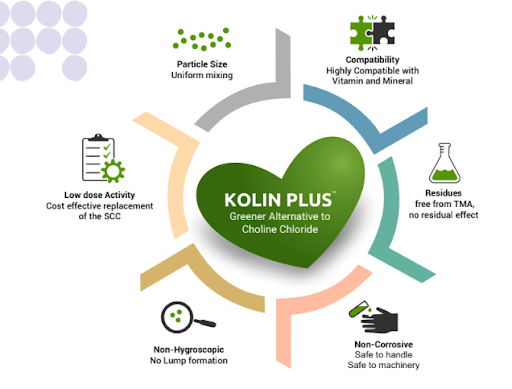
Farmers increasingly prefer Kolin Plus because it is easy to handle, non-hygroscopic, and environmentally friendly, making it practical for everyday farm use. Beyond on-farm benefits, Kolin Plus also supports sustainability—helping reduce over 1 billion carbon footprints so far. Its production generates significantly lower emissions, with around 579 kg CO₂ equivalent per ton compared to about 1,020 kg CO₂ equivalent for synthetic choline chloride. This makes Kolin Plus a reliable choice for farmers who want consistent performance with a lower environmental impact.